
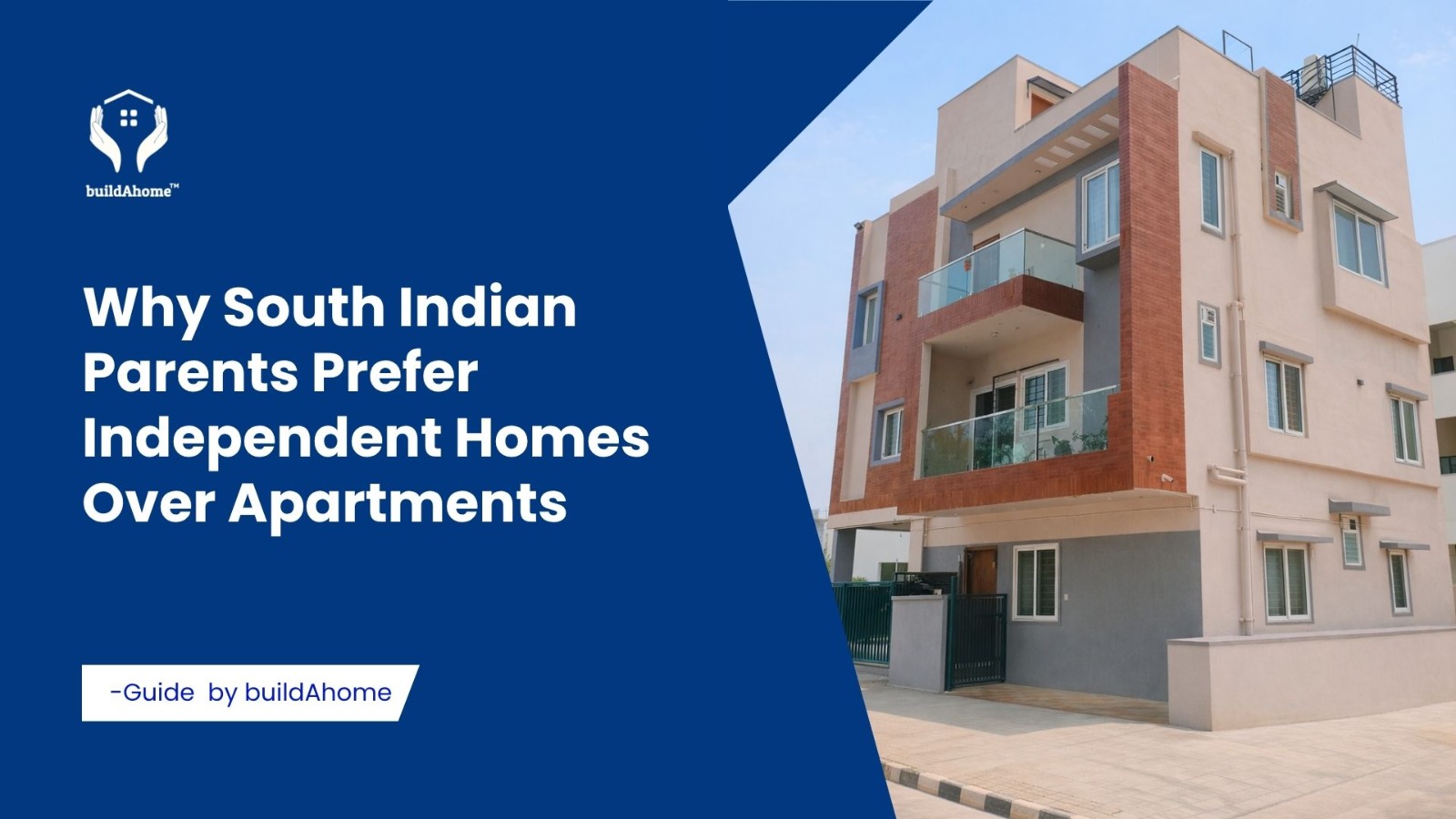
Across South India, the skyline is changing rapidly with gated communities and high-rise towers. Yet when it comes to securing their children’s future, many South Indian parents still prefer independent homes over apartments. This preference is not emotional alone — it is backed by economic logic, urban realities, cultural design needs, and long-term wealth planning.
From decades of observing the house construction industry in South India, one pattern is clear: independent homes are viewed as a multi-generational asset, not just a place to stay.
1. Land Ownership Is the Core Decision
Unlike apartments, independent homes come with direct land ownership. Structurally, buildings depreciate. Land appreciates. This principle drives most parental decisions.
Data from the Department of Stamps and Registration shows that guidance values for residential land parcels in major South Indian cities have steadily increased over the past decade, while resale values of older apartments stagnate once the building ages 15–20 years.
Parents understand one key fact:
Apartments are shared assets within a structure. Independent homes provide absolute ownership of land.
In growing corridors of cities like Bengaluru, plotted developments have historically shown stronger long-term appreciation compared to mid-segment apartments due to land scarcity
2. Cultural Architecture Cannot Be Compromised
South Indian homes are designed with intention — east-facing entrances, pooja rooms, internal ventilation courtyards, vastu-compliant layouts, and utility zones for traditional cooking during festivals.
A study by the Indian Institute of Science highlights how tropical urban climates require cross-ventilation and passive cooling techniques to maintain thermal comfort. Independent houses allow:
● Thicker insulated walls
● Better window placement for airflow
● Shaded verandahs
● Rainwater harvesting integration
Apartments often depend more on mechanical cooling due to compact planning and glass-heavy facades.
Parents building homes think in 25–30 year cycles — not short-term convenience.
3. Autonomy Over Lifestyle Decisions
Apartment associations regulate pets, renovations, rentals, solar installations, and even minor structural changes. Independent homeowners retain flexibility.
With the rise of remote work and home-based entrepreneurship, this matters. An independent house allows:
● Adding rental floors
● Creating a clinic or office space
● Installing rooftop solar panels
According to policy support under the Ministry of New and Renewable Energy, rooftop solar adoption is significantly smoother for individual homeowners than for multi-unit buildings due to approval structures.
Parents consider adaptability. What if their child starts a business from home? What if they need space for aging parents?
Independent homes allow evolution.
4. Multi-Generational Planning
South Indian families often prefer joint or near-joint family systems. Apartments limit flexibility to 2BHK or 3BHK structures.
Independent house construction enables:
● Separate floor for elderly parents
● Rental unit for passive income
● Private workspace for children
● Future vertical expansion
This modular growth is rarely possible in apartments without heavy restrictions.
In cities like Bengaluru, reverse migration trends — where elderly parents move in with children working in the tech sector — have increased demand for flexible home designs.
5. Water & Resource Security
Water scarcity cycles have become a serious concern across South Indian cities. Independent homes can integrate:
● Private borewell systems
● Custom sump storage
● Advanced rainwater harvesting
Apartment residents rely on shared tanker systems and association decisions. Parents, especially those who have seen drought cycles in the past, value direct control over essential utilities.
Resource autonomy equals security.
6. Transparency in Construction Quality
In apartments, buyers rarely know the depth of foundation, grade of concrete, or steel quality used.
With a trusted house construction company, families can:
● Monitor material selection
● Customize structural strength
● Ensure long-term durability
South Indian parents tend to be detail-oriented investors. They prefer knowing how their home is built — not just how it looks.
7. Psychological Security of “Own Property”
In South India, gifting a child an independent home carries emotional and social value. It signals stability. It signals legacy.
An apartment is seen as a residential unit.
An independent house is seen as a family asset.
This difference strongly influences parental preference.
When Apartments Make Practical Sense
Apartments are suitable for:
● Young professionals with mobility
● People prioritizing amenities
● Short-term urban living
However, when the objective is generational wealth, adaptability, and land ownership, independent homes dominate the decision-making process.
Final Perspective
South Indian parents are not rejecting apartments due to tradition alone. Their choice is data-driven, climate-aware, and financially strategic.
Independent homes offer:
- Appreciating land value
- Cultural design freedom
- Resource security
- Multi-generational expansion
- Lifestyle autonomy
In select high-growth markets like Bengaluru, this preference is visibly shaping demand toward plotted developments and custom home construction.
When parents build, they are not just constructing walls.
They are designing permanence.
And in South India, permanence begins with owning the land beneath your home.