


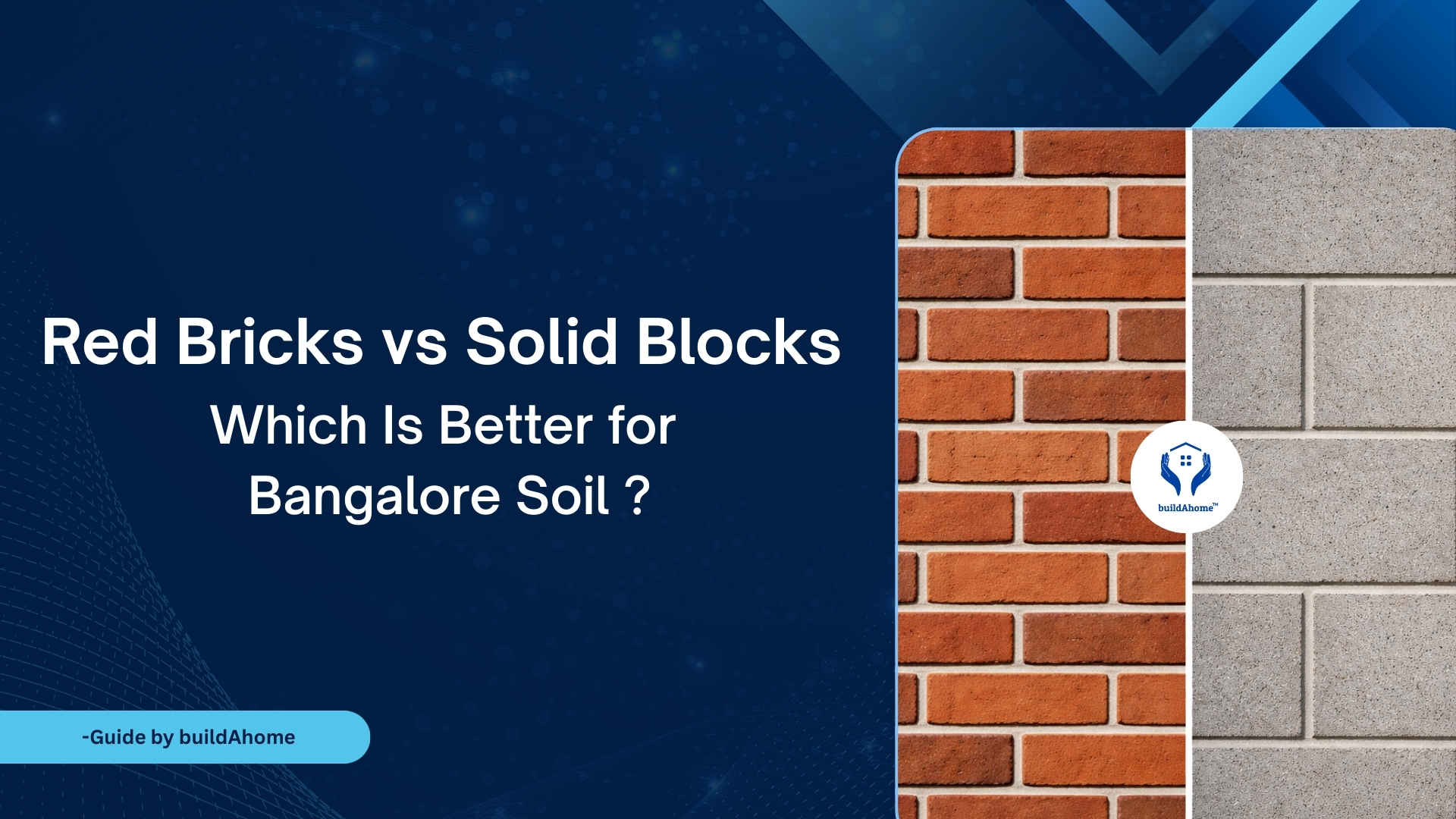
If you’re planning house construction in Bangalore, the choice between traditional red bricks and solid concrete blocks is not just a cost decision—it’s a soil–structure compatibility decision. Bangalore’s ground conditions behave very differently from most Indian cities, and this single factor quietly decides whether your walls age gracefully or start demanding repairs far too early.
Many homeowners approach this decision with generic advice from suppliers, but experienced house construction companies in Bangalore know that material selection must start from soil behavior, not market trends. This is exactly why companies like buildAhome, which plan homes based on site-specific soil testing and structural logic, tend to deliver houses that perform better over decades—not just at handover.
This blog breaks down what actually works for Bangalore soil, based on local geotechnical studies, recent material research, and on-site construction behavior—not generic textbook comparisons.
Understanding Bangalore Soil (Why This Debate Matters Here)
Most residential layouts across Bangalore sit on residual red lateritic soil formed from weathered granite-gneiss rock. Key characteristics builders often overlook:
● High bearing capacity when dry, but volume instability with moisture variation
● Low organic content, but micro-fissuring under seasonal shrink–swell cycles
● Increasing groundwater fluctuations due to urban borewell dependency
This soil doesn’t fail suddenly—it transfers stress slowly and unevenly to masonry walls. That’s where material choice becomes critical.
Red Bricks: Time-Tested, but Not Always Time-Proof
Red clay bricks have been used in Bangalore for decades, but recent lab testing by IISc-affiliated civil material researchers (2022–2024) shows that brick performance varies drastically depending on sourcing and firing quality.
Why Red Bricks Still Work in Bangalore
● Thermal comfort advantage: Red bricks have higher thermal mass, keeping homes cooler during Bangalore’s warm afternoons, still a big plus for independent houses.
● Better micro-crack accommodation: Brick masonry with lime-modified mortar absorbs small soil movements better than rigid systems.
● Superior sound insulation: Particularly useful in dense residential layouts and villas near main roads.
Hidden Drawbacks Most Builders Won’t Tell You
● Water absorption averages 18–22% for locally supplied bricks—this directly increases dampness risk in Bangalore’s monsoon-heavy zones like Whitefield and Yelahanka.
● Non-uniform compressive strength: Even within the same batch, strength variation can be as high as 30%, increasing long-term crack probability.
● Higher structural dead load: On weak pockets of soil, this amplifies foundation settlement over time.
Best Use Case
Red bricks perform best for low-rise individual homes (G+1) where soil testing confirms stable strata within 5–6 feet and when plinth waterproofing is executed flawlessly.
Solid Concrete Blocks: Engineered for Modern Bangalore Homes
Solid blocks are not just “bigger bricks.” Modern solid blocks manufactured around Bangalore now follow IS 2185 (Part 1) with machine compaction, which has changed the game.
Why Solid Blocks Are Gaining Ground
● Low water absorption (≤10%) significantly reduces efflorescence and damp patches—especially important in borewell-dependent sites.
● Uniform compressive strength ensures even load transfer to foundations, which is crucial for uneven lateritic soil layers.
● Reduced mortar consumption: Larger block size means fewer joints, reducing shrinkage cracks caused by soil movement.
● Faster construction cycles, lowering overall project timelines for residential construction in Bangalore.
The Trade-Offs You Should Know
● Higher rigidity: Solid blocks don’t “forgive” poor foundation design. Any soil misjudgment reflects as visible cracks.
● Thermal conductivity is higher than red bricks, requiring external insulation or cavity wall planning for optimal comfort.
● Quality dependency: Locally cured, non-certified blocks can underperform—supplier selection matters more than material choice.
Best Use Case
Ideal for G+2 and above structures, compact urban plots, and projects where soil bearing capacity varies across the site—a common Bangalore issue.
So… Which Is Better for Bangalore Soil?
There is no universal winner—but there is a smarter choice per situation.
● Choose red bricks if you’re building a villa or independent home, value thermal comfort, and have confirmed shallow stable soil with proper drainage planning.
● Choose solid blocks if your project involves multiple floors, tighter timelines, or mixed soil profiles, and if structural uniformity is a priority.
Pro Tip from Site Experience
Many premium house construction companies in Bangalore now use a hybrid approach—solid blocks for lower floors (where soil stress is highest) and red bricks for upper levels to balance weight, comfort, and longevity.
Final Word for Bangalore Homeowners
Material choice should follow soil behavior, not trends. A ₹40 saving per block means nothing if your walls demand crack repairs in five years.
At buildAhome, every project begins with soil testing, structural load evaluation, and material compatibility planning—because in Bangalore, the ground always gets the final say. If you’re serious about long-lasting, low-maintenance home construction in Bangalore, working with a team that respects the soil can make all the difference.